
Exiting the Income Class
Part One: Start Your Engines

Last month we wrote a piece about the “Income Class vs the Capital Class” which provoked the most inbound response from readers, ever. They all largely asked the same thing:
“HOW DO I LEAVE THE INCOME CLASS?”
That is the entire point of this special series.
Here’s the piece that started all of this, in case you missed it:

If you read the first article, you understand the trap.
You see the Labor Economy for what it is: a linear grind. It is a treadmill where the speed increases every year while your legs get tired. You understand that the Capital Economy is where the exponential returns live. It is where the freedom is.
Now you have a question.
“How do I get to the Capital Economy?”
You are standing on one side of a massive canyon. On your side, people are trading hours for dollars. On the other side, people are trading assets for freedom. You want to build a bridge.
Most people never build it. They stare at the other side. They complain about the unfairness of the geography. They wait for a politician to build the bridge for them.
That bridge is never coming.
You have to build it yourself.
The Labor Economy trains you to be a specialist. You are an accountant. You are a coder. You are a manager. You have one identity. You have one income stream. You have one point of failure.
To succeed in the Capital Class, you must become something else.
You, Inc.
You must become a Holding Company.
You are no longer a person with a job. You are the CEO of a collection of assets. Your job is not to work. Your job is to allocate resources to build engines.
These engines are wealth generators. They run simultaneously. They feed each other. They are designed to decouple your financial output from your physical input.
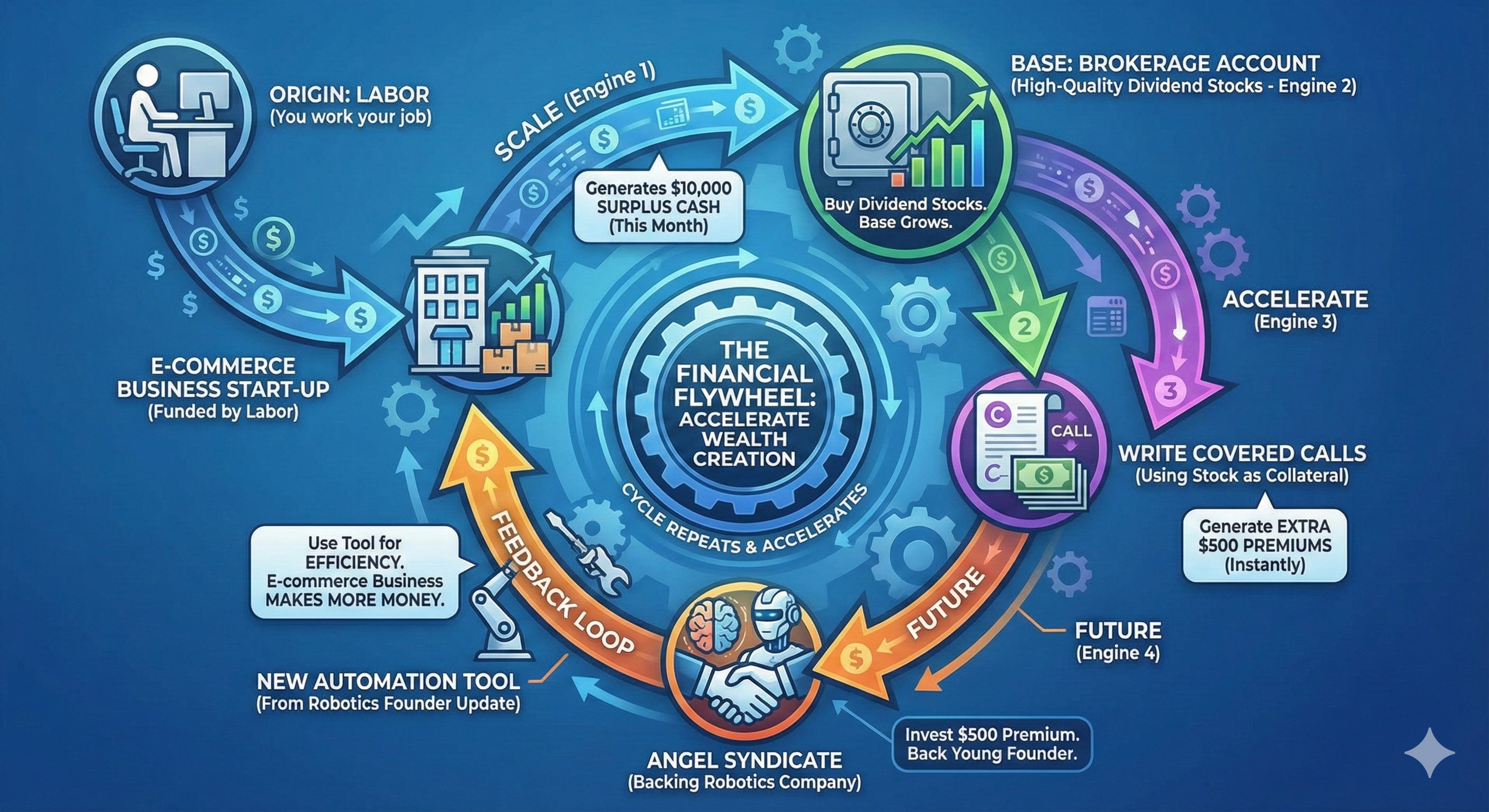
I am going to show you a blueprint. There are infinite modules and ways you can structure Wealth Systems.
This is not a get-rich-quick scheme. This is a get-rich-permanently system. It requires work. It requires learning. It requires an absolute obsession with technology and systems.
We are going to build four specific engines.
The Cash Flow Engine: Scaling an E-commerce Business.
The Stability Engine: Dividend Investing.
The Yield Accelerator: Writing Options at 30-45 DTE.
The Future Engine: Angel Investing.
Let’s build the machine.
Engine 1: The Cash Flow Engine
To leave the Labor Class, you need surplus capital. You cannot invest your way to wealth if you are living paycheck to paycheck. You need a firehose of cash.
Your salary is not a firehose. It is a drip. It is capped by your hours.
You need a business.
Specifically, you need a digital product or e-commerce business.
Why e-commerce? Because it is the only business model where the store is open 24 hours a day, 365 days a year, to a global audience, without you needing to be there.
I am a techno-optimist. I believe we are living in the golden age of the individual builder.
Ten years ago, building a global retail brand required millions of dollars. You needed warehouses. You needed a logistics team. You needed expensive servers.
Today you need a laptop and an internet connection.
The tools available to you are staggering. Shopify gives you the infrastructure of a Fortune 500 retailer for a monthly subscription. AWS gives you the computing power of a nation-state. AI tools can write your copy, design your logo, and handle your customer service.
You are not just selling products. You are building a system.
The Philosophy of Scaling
Most people fail at e-commerce because they treat it like a job. They box the products themselves. They answer every email. They are just doing labor in a different setting.
The Capital mindset is different. You must automate or outsource everything.
You use Third-Party Logistics (3PL) providers to hold and ship your inventory. When an order comes in, a computer tells a warehouse in Ohio to ship it. You don’t touch it.
You use algorithmic advertising to find customers. You feed data into Meta or Google. The machine learns who buys. It finds more of them.
This is your first asset. It is not a job. It is a digital machine that prints money while you sleep.
The Goal
The goal of this engine is not just income. It is to create “Free Cash Flow.” This is money that is not needed for your living expenses. This is the fuel for the other engines.
When you scale an e-commerce brand from $1,000 a month to $10,000 a month, you are not just making money. You are creating an asset that can be sold.
Remember the Private Equity guys from the first article? They buy cash flow. If you build a store that generates $1 million in profit a year, you can sell that asset for $3 million to $5 million.
That is the exit. That is the Capital Class.
But before you sell, you use that cash flow. You pour it into the next engine.
You can borrow against the cash flow and use that power the activation of another wealth engine.
Engine 2: The Stability Engine
The E-commerce engine is aggressive. It is volatile. Algorithms change faster than consumer tastes. Supply chains break. You can have a bad month.
You need a bedrock.
You need an engine that never stops, never sleeps, and never goes to zero.
You need Dividend Investing.
This is the unsexy, boring basement of your skyscraper. It is essential.
In the Labor view, investing is about “saving for retirement.” You hope the number goes up so you can sell it when you are 65.
In the Capital view, investing is about buying income streams and creating assets you can leverage.
When you buy a share of a dividend-paying company, you are buying a claim on their future profits. You are becoming a silent partner.
Coca-Cola sells sugar water to billions of people. Johnson & Johnson sells band-aids. Realty Income collects rent from thousands of commercial properties.
You buy the share once. They pay you forever.
The Reinvestment Loop
The magic here is not spending the dividends. It is the DRIP (Dividend Reinvestment Plan).
This is a recursive loop.
You own shares.
The shares pay you cash.
The computer automatically uses that cash to buy more shares.
You now own more shares.
The next payment is larger.
This is exponential growth in its purest form.
You take the profits from your E-commerce engine (Engine 1) and you allocate some of them here. You are converting “active, risky cash” into “passive, permanent cash.”
You are buying your freedom one share at a time.
Eventually, this engine covers your mortgage or rent. Then it covers your food. Then it covers your life.
Once your basic needs are covered by dividend income, you are virtually unkillable. You have exited the rat race. You can take risks that others cannot.
But 3% yields are slow. We are techno-optimists. We are impatient. We want to accelerate the process.
That brings us to the third engine.
Engine 3: The Yield Accelerator
This is where the professionals play. This is where you stop being a “retail investor” and start acting like the House.
